
The AI Productivity Paradox Is Mostly a Prompting Problem
Studies keep finding AI adds work instead of saving it. A surprising share of that hidden tax isn't the model's fault - it's how we prompt.
MDCrafter Team
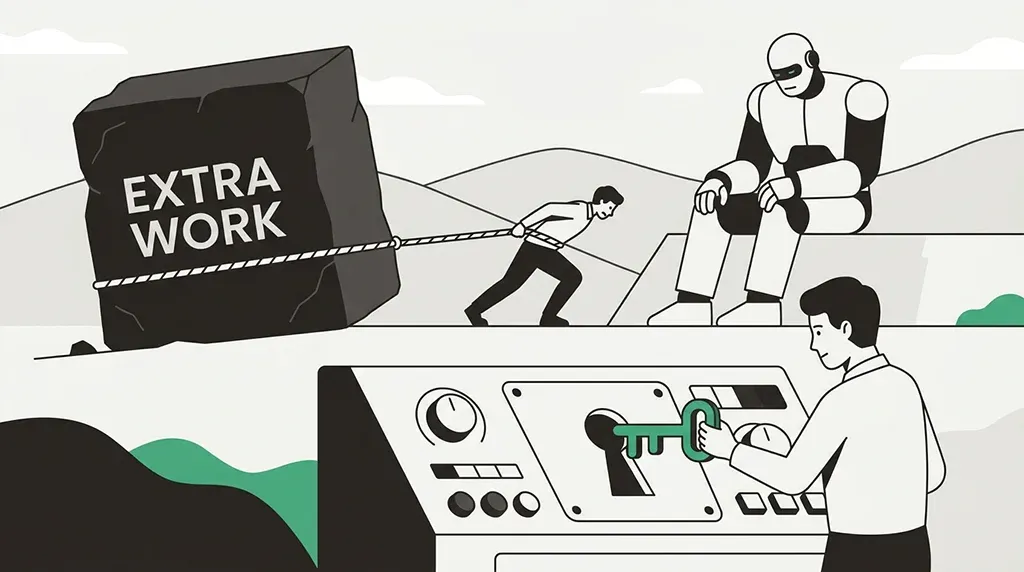
Ask a room full of executives whether AI will make their teams more productive and 96% say yes. Ask the people doing the actual work and 77% say their workload went up, not down. That gap has a name now: the AI productivity paradox, and if you've quietly wondered why the tool everyone calls game-changing hasn't handed you a single free afternoon, you're not imagining it.
The uncomfortable part isn't that AI does nothing. It's that a lot of the time it saves gets clawed straight back - and a surprising share of that clawback is fixable.
The numbers behind the AI productivity paradox
Start with the studies, because they're bleak in a very specific way. MIT's Media Lab found that 95% of corporate AI projects deliver zero measurable financial return, even though AI use at work has doubled since 2023. Harvard Business Review summed it up in one line: 'So much activity, so much enthusiasm, so little return.'
The perception gap is stranger still. In a randomized controlled trial, METR had experienced open-source developers work with and without AI coding tools. They were 19% slower with AI - and afterward believed they'd been 20% faster. That's not a rounding error; that's people misreading their own speed by nearly 40 points. A three-month UK government trial of Microsoft 365 Copilot landed in the same place: no discernible productivity gain, some tasks faster, others slower because the output needed fixing.
AI productivity theater
Then there's the performance layer. A growing share of workers feel pushed to use tools they don't trust - 22% say they feel pressured to use AI they're unsure about, and 16% admit they pretend to use it just to look compliant. This is AI productivity theater: activity staged for a manager who's measuring adoption instead of outcomes. When the metric is 'did you use AI,' you get people using AI badly to hit the metric, which is how you manufacture workslop on purpose.
Why doesn't AI make me more productive? Look at the prompt
Here's the part most coverage skips. The org-level diagnoses - fragmentation tax, theater, the mirage of gains - are real, but abstract. Zoom into the individual mechanism and a lot of the tax traces back to something you control: how you ask.
The engineer Shrivu Shankar argues most people land at only 10-20% more productive no matter how game-changing the tool supposedly is, and the reason is workflow, not model capability. People fire off a vague prompt, get a vague answer, re-prompt, then get stuck manually verifying output instead of building a repeatable loop that checks itself. Meanwhile organizations happily automate the 20% of work AI is good at - drafting - and leave the 80% of review, approval, and coordination fully manual. Atlassian estimates that mismatch, the 'fragmentation tax,' at $161 billion a year across the Fortune 500.
The practitioner mood matches. On the professional forum Blind, one engineer said ChatGPT only 'marginally increased my productivity,' another said it 'just sends me down countless rabbit holes,' and a third found it genuinely useful for exactly one narrow job - writing regex. That's the prompt-engineering time sink in miniature: you're not slow because AI is weak, you're slow because a loose prompt guarantees a rework loop.
Closing the gap without chasing hype
None of this means resigning yourself to 10%. It means the lever is your prompting and your workflow, not the next model release. A few habits move the needle more than any upgrade:
- Specify the output shape up front - exact format, length, and structure - so you stop reformatting by hand. One format instruction prevents more rework than any 'act as an expert' persona.
- Give the model your real constraints and source material instead of making it guess; most verification time is spent catching things you could have stated in the prompt.
- Build closed loops: ask the AI to check its own work against your criteria before you read it, so review isn't entirely on you.
- Install the three prompts you actually reuse into custom instructions or a project, so the good version fires by default instead of being retyped loosely every time.
- Measure outcomes, not usage. If a task genuinely got slower - like METR's developers - drop AI for that task without guilt.
The honest version of the promise
AI is real leverage on a narrow band of work and a net drag on some of the rest. The people who come out ahead aren't the ones using it the most; they're the ones who've figured out which 20% it actually helps and built tight prompts and loops around exactly that. The paradox isn't a life sentence - it's mostly a signal that the workflow around the tool hasn't caught up to the tool, and that's something you can fix this week rather than wait on a lab to solve.
References
- Harvard Business Review - "AI-Generated 'Workslop' Is Destroying Productivity"
- METR - "Measuring the Impact of Early-2025 AI on Experienced Open-Source Developer Productivity"
- Yahoo Finance - "Almost half the time saved using AI is spent correcting outputs" (Workday survey)
- Shrivu Shankar (blog.sshh.io) - "How AI Productivity Fails"
- Atlassian - "The AI efficiency paradox: What to do when AI boosts productivity but not results"
Enjoyed this? Get the weekly craft.
One crafted prompt in your inbox each week, with the reasoning behind it.
Free. Unsubscribe anytime.
Keep going
More to read
Guide
Effective Prompt Engineering for Daily Productivity
Prompt engineering for everyday work isn't secret syntax. It's context engineering in miniature: handing the model context, audience, format, and constraints, then iterating. Here's the full playbook.
Prompt
Prioritize a Task Pile With the Eisenhower Matrix Without Everything Landing in 'Urgent'
Fixes the two ways the Eisenhower matrix actually fails you: it makes you define what 'urgent' and 'important' mean for YOUR goals instead of guessing, sorts your whole task dump for you so working memory doesn't blur by task 12, and hands back a concrete next action per quadrant - plus it forces an impact-first re-rank when everything crashes into 'urgent and important.' Once the pile is sorted, protect time for the top quadrant with our deep work session planner so it doesn't just get re-sorted next week.
Tool
Prompt Crafter
Fill in role, task, tone and format, and get a clean, structured AI prompt back. No AI calls.